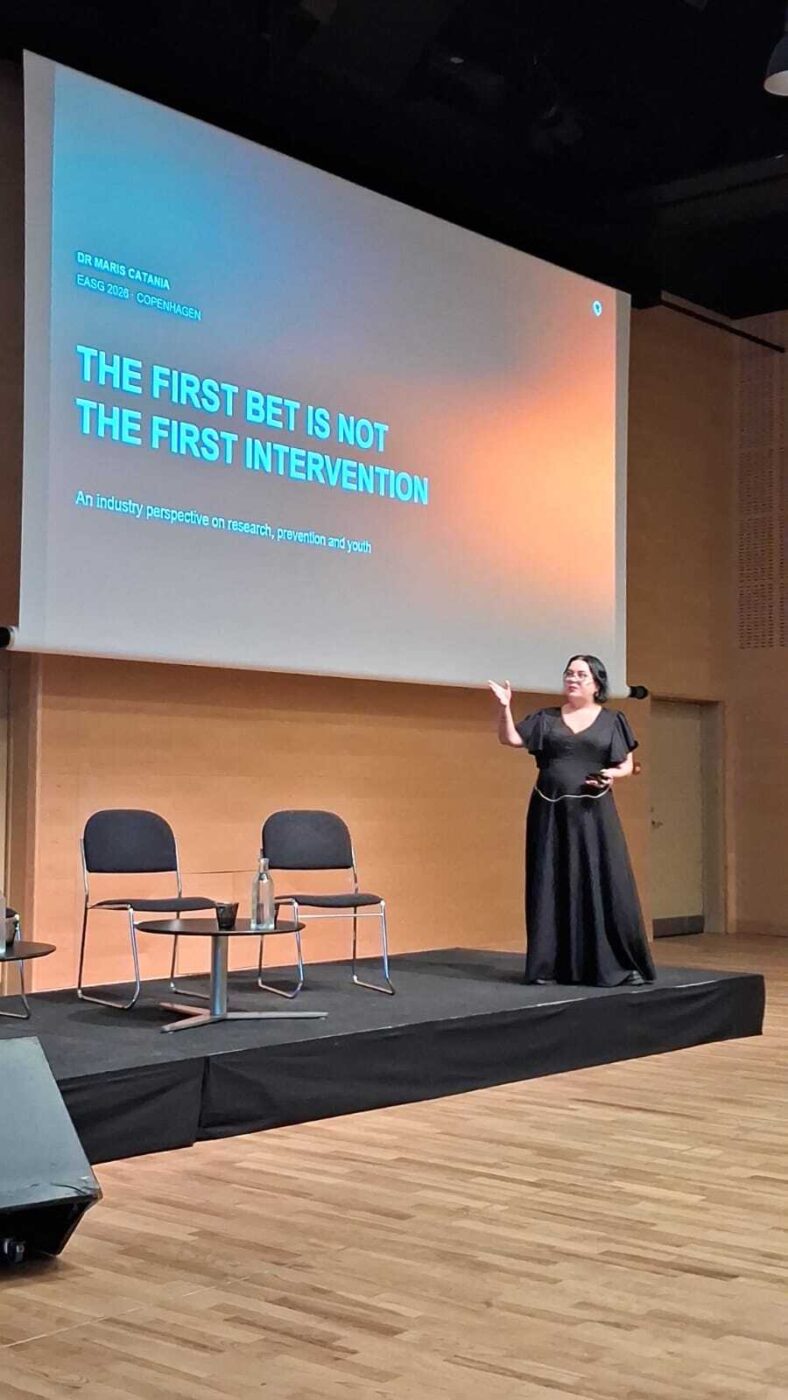
At the European Conference on Gambling Studies and Policy Issues in Copenhagen, Dr Maris Catania, Director of Player Sustainability at LeoVegas Group, explored how the industry must prepare for a new generation of players whose exposure to gambling-like mechanics may begin long before they are legally able to gamble. The conference was organized by European Association for the Study of Gambling (EASG).
We spoke with Maris following her EASG presentation, “The First Bet Is Not the First Intervention: An Industry Perspective on Research, Prevention and Youth.”
What do you mean when you say that “the first bet is not the first intervention”?
Traditionally, operators begin their relationship with a player at registration, deposit or the first bet. However, that is not necessarily where the individual’s relationship with gambling-like experiences begins.
The next cohort of adult players will have grown up in a digital environment filled with variable rewards, virtual currencies, randomised items, social competition and mechanics designed to extend engagement. This does not mean that gaming automatically leads to gambling harm, and we need to be careful not to overstate that relationship. However, it does mean that an 18-year-old entering an online gambling environment may already be familiar with many of its underlying mechanics. Prevention therefore cannot begin only after harm becomes visible. We need to understand what people bring with them into gambling, how earlier digital experiences may shape their expectations, and how we can build protection into the customer journey from the outset.
You talk about AI shifting us from “risk scoring” to “next-best safe action”. Can you give a concrete example of what that action actually looks like in practice?
A risk score tells us who may require attention, but it does not automatically tell us what will help that particular person. Two players can display a similar level of risk while requiring very different responses. One may benefit from a simple reality check or an easy way to set a limit. Another may need a more direct interaction, a pause in promotional activity or stronger protective measure.
The opportunity for AI is not simply to predict risk more accurately. It is to support better decisions about the timing, channel, tone and intensity of the intervention. It can also help us understand whether the action worked and what should happen next. The aim should be first-contact resolution wherever possible: recognising the player’s circumstances, responding appropriately and reducing the need for repeated or disconnected interventions.
The same player data can trigger opposing systems: one optimizing for revenue, one for player safety. How does the industry generally resolve that kind of conflict when the two collide?
This is one of the most important governance questions facing the industry. The same data could lead a commercial model to identify a player as having high potential value while a player-safety model identifies escalating risk. One system may recommend a promotion or reduced friction, while the other recommends pausing marketing, initiating an interaction or introducing protective friction.
AI does not remove that conflict. Without clear governance, it can automate it.
Organisations therefore need to decide in advance which objective takes priority, who has the authority to override an automated decision, and how those decisions will be recorded and reviewed. When objectives conflict, the strongest short-term KPI can otherwise become the default winner. Player protection must be embedded within the decision architecture, rather than operating as a separate system.
You end with the idea that revenue dependent on harm isn’t sustainable revenue. Are you seeing that principle already show up in how operators design their systems?
There is growing recognition that player sustainability and business sustainability should not be treated as opposing objectives. A sustainable player relationship may mean fewer disputes, refunds, chargebacks, complaints, repeated contacts and regulatory escalations. It can also support greater trust and a more durable relationship with the player.
However, this requires us to measure meaningful outcomes, not simply whether an intervention was delivered. We need to understand whether it helped the player, whether behaviour changed appropriately, whether unnecessary friction was avoided and whether the overall journey became safer. Ultimately, the question is not only whether we can identify risk earlier. It is whether we are prepared to act on that knowledge in a way that places long-term player wellbeing at the centre of the decision.
Is there anything else you would like people to take away from the presentation?
My personal takeaway is that we cannot keep treating young people as though their relationship with gambling begins suddenly on their eighteenth birthday. We are seeing a new cohort entering legal gambling who may already have years of experience with gambling-like mechanics, instant rewards, virtual currencies and highly personalised digital environments. That does not mean every young person exposed to these features will experience gambling harm. However, it does mean that the starting point has changed, and our approach to prevention must change with it.
A special thank you to Ynze and Pieter Remmers for the considerable work they continue to put into EASG. Creating a conference that has remained so relevant, thought-provoking and valuable over so many years is no small achievement.
It was also a privilege to share the plenary session on research, prevention and youth with Jeffrey Derevensky, Michael Auer, and Pedro Romero, under the chairmanship of Peter Wilson. Each contribution approached the subject from a different perspective, from changing patterns of youth gambling and developments in responsible gaming to turning research and lived experience into practical prevention.
Thank you as well to everyone who attended, challenged the ideas and continued the discussion afterwards. These conversations, particularly between people who may not always begin from the same position, are what make EASG so worthwhile.